

Have you been studying English for years? Yet, every time you need to speak, does your heart race, your mind go blank, and your mouth freeze up?
You are not lazy. You have tried very hard—going to English centers, studying grammar books, and using learning apps. But the moment you stand in front of an English native speaker, everything disappears.
Hieu was exactly like that.
Hieu studied English for nearly 10 years, from middle school through university. He worked hard on grammar and vocabulary and got high grades at school, so he felt confident.
That changed when he applied for the Fulbright Scholarship—a program taught entirely in English. Hieu realized his biggest weakness: Listening and Speaking.
He tried everything: watching movies, listening to podcasts, and downloading speaking apps. But the harder he tried, the more insecure he felt. From being confident, Hieu started feeling incompetent. "Why have I studied for so long but still can't speak?" he asked himself.
But today, Hieu is different. Not only did he win the 100% Fulbright scholarship, but he now confidently debates and discusses complex topics in English with professors.

Do you wonder how Hieu made such a breakthrough? In this blog, eJOY will explore with you:
- 4 golden principles to help you speak English fluently.
- A self-study guide that you can start today.
This is not just theory. This is the result of nearly 10 years of experience supporting 5,000+ real learners at eJOY.
It will take you about 30 minutes to read. But you will grasp what takes many people 10 years to realize. This could be the turning point that changes how you learn English forever.
The 4 golden principles to speak English fluently
Principle 1: Set Realistic Goals
Many people want to speak confidently at work but choose a goal that is easy to measure, like IELTS. This accidentally makes learning harder. Why? Because academic IELTS topics rarely appears in daily office life. As a result, you study hard but still can't speak in real work situations, and you lose motivation.
So, how do you set the right goal?
Ask yourself: "Why do I want to learn English?"
- For a better job: Look at the requirements of the position you want.
- For a certificate: If the company/school requires IELTS, then study IELTS.
- For communication at work: Focus on Business English. Your goal should be CEFR Level B1 or B2 and mastering 100 office situations.
- For living abroad: Aim for Level B1+ and master 100 daily life situations.
Some learners set realistic goals but eventually give up, believing they aren't 'gifted' at languages. In reality, the problem isn't their talent—it's that they haven't accumulated enough practice hours.
Principle 2: Accumulate Enough Time
Hieu used to believe he studied hard.
During high school, he spent 1 hour per week doing grammar exercises. It sounds okay, but it was not enough to create a change.
According to Cambridge, to communicate confidently (Level B1), you need 350–400 hours of practice. To jump from A2 to B1, you need about 200 hours of active learning.
The Truth: Progress does not come from how many years have passed. It comes from how many hours you actually practice. If you study for 3 years but only 10 minutes a day, you only have about 200 hours total. That is not enough to reach B1.
But most learners—like Hieu in the past—only accumulate a few dozen hours of real study over an entire year.
When you don’t measure your active practice hours, you cannot know where you stand. As a result, year after year, you remain stuck in the same spot.
However, even if you have a clear goal and have accumulated at least 200 hours, you still won't communicate fluently if you don't use the right method. You can easily fall into the trap of “understanding what you hear and read, but being unable to speak.”
Principle 3: The Right Method – The F.E.P Model
Hieu studied grammar and new vocabulary every week. Yet, whenever he needed to speak English, he still had to piece together every word in his head and double-check grammar rules. It took him up to 5 minutes just to speak one complete sentence.
The reason was that Hieu studied in an unbalanced way. He spent too much time on theory without practicing speaking or applying it in real life.
So, what is the best way to learn? The answer lies in combining three activities: Feed – Exercise – Perform. This is the F.E.P Model.

#1: Feed
This step involves acquiring language to build a "data warehouse" for your brain. There are two main types of "Feeding": Intentional Feed and Natural Feed.
Intentional Feed: This is when you learn with a specific purpose: understanding grammar, rules, sentence structures, and word usage. The goal is to help you understand exactly how the language works so you can use it correctly and flexibly in different situations. Studying grammar rules back in school is a perfect example of Intentional Feed.
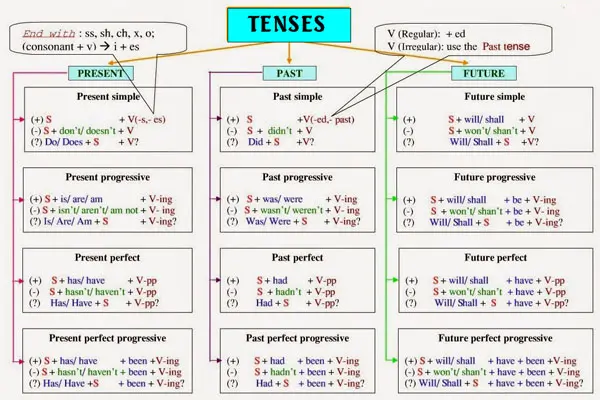
Natural Feed: This is when you let English enter your mind naturally through movies, podcasts, stories, and news. The goal is to help you feel the intonation, rhythm, and natural expressions of native speakers.
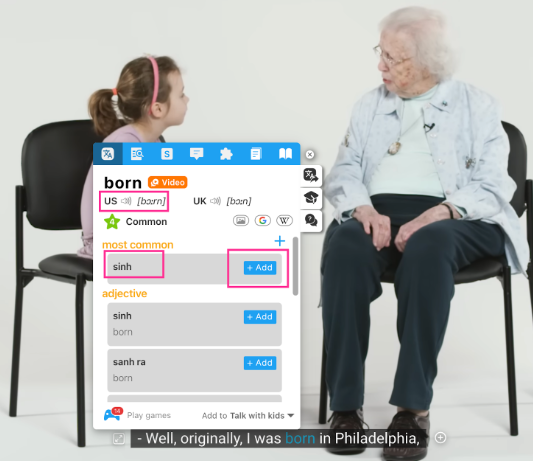
Example:Imagine you are watching a YouTube video of a conversation between a baby and a 101-year-old woman with English subtitles.
- Natural Feed: You hear the sentence: “Well, originally, I was born in Philadelphia.” Even if you don't know the words "originally" or "born," you keep the video playing. You don’t stop to look them up; instead, you guess the meaning based on the context.
- Intentional Feed: If you pause the video, open a dictionary to find the meaning of "born," check its pronunciation, and save it to your notebook to review later—that is Intentional Feed.
#2: Exercise
Exercise is the stage where you practice with intention, repeat many times, and get feedback so that everything you heard and all the grammar you learned can turn into clear, effective output. You need to train different skills, and whichever skill you are weak at — that’s the one you should focus on.
Example: Using the same conversation between the little girl and the 101-year-old grandmother from the Feed stage, you pick a short sentence like:
“Well, originally, I was born in Philadelphia.”
You listen and repeat it, then get feedback on your pronunciation. If you realize you’re mispronouncing “originally,” you adjust it little by little each time you practice. That is accuracy training.
If you repeat the whole sentence smoothly, matching the character’s speed and intonation. That is fluency training.
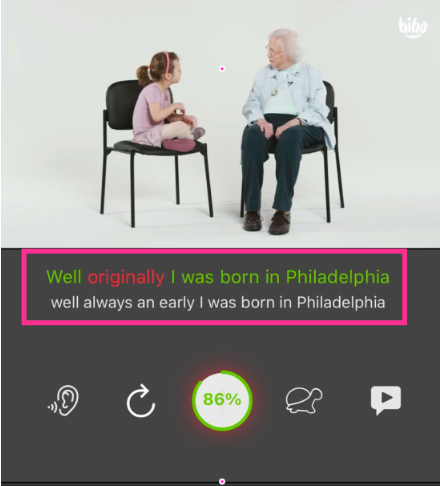
If you have a teacher or a coach, they can give you instant feedback after each attempt so you can fix mistakes right away.
If you study on your own, record your voice and compare it with the original, or use speaking tools that provide instant feedback. These tools help you catch mistakes right at the moment you make them, so you can correct them immediately.
#3: Perform
Learning English is like a child learning to ride a bicycle.
First, the child gets Feed — theoretical knowledge: how to balance, how to brake, how to turn.
Then comes Exercise — practicing in a safe, controlled environment: balancing inside the house, trying the brakes, practicing small turns.
But if the child stops there, once they go outside — where there are cars, people, and obstacles — they will panic and won’t know how to combine all the skills. As a result, they still can’t ride confidently.
English learners are the same. To speak naturally with native speakers, you need to Perform — “real-world use,” where you combine all your skills (listening, speaking, reading, writing, vocabulary, grammar) to achieve a real communication goal.
Unlike the Exercise stage, which is structured and gives clear feedback, the Perform stage requires flexibility, quick reactions, and the ability to adapt in real situations.
Example: In the Feed and Exercise stages, you learned the sentence:
“Well, originally, I was born in Philadelphia.”
Now it’s time to use it in real life.
You can:
- Introduce yourself at work: “Well, originally, I was born in Hanoi.”
- Or when talking with AI, instead of the simple “I’m from Hanoi,”
you can expand: “Well, originally, I was born in Hanoi, but I’ve been living in Ho Chi Minh City for 5 years.”
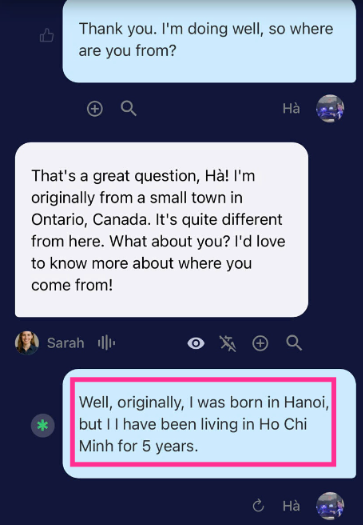
Now you’ve taken the structure “I was born in…” and personalized it.
Please note: To reach B2 level and beyond — to speak naturally, understand deeply, and respond flexibly, you must combine all 3 stages:
Feed → Exercise → Perform.
It’s just like a child in primary school: even though they already speak their mother tounge fluently, they still need to learn grammar to write well and tell stories clearly.
Similarly, to level up your English, you need feed, practice and perform.
Only when all three come together will your communication become smooth and confident, like a native speaker.
Analyzing Common Learning Solutions
Let's look at the table below to see which activities different English learning methods actually focus on.
Every English learning solution has its own pros and cons, serving to sharpen specific skills at different stages. Some tools help you master grammar, others focus on pronunciation, while some are designed to improve speaking fluency.
The problem is that many learners focus on just one group of activities—usually just Feeding Input —without actively practicing or performing. The result? You may have excellent listening comprehension, but when it’s time to communicate, you get stuck for words and lack the reflexes to respond.
To truly improve, you need to combine three core activity groups: Feed – Exercise– Perform. Only when these three act in sync can you achieve the goal of confident, fluent communication.
Therefore, if you hear an ad promising "fluency in 3 months," check if that course actually helps you hone all three of these activities, and ask yourself if it provides enough time for active practice.
Consider an app that markets itself as having 1,000 lessons. If each lesson is only 5 minutes, completing the whole app only gives you about 83 hours of exposure. However, if the majority of those lessons revolve around vocabulary, grammar, or topics you don't need, the amount of time that is actually useful to you is much lower.
Unlike these standalone tools, eJOY is designed as a comprehensive English ecosystem. It helps you balance Feed - Practice- Perform. You can learn for thousands of hours in a flexible way that suits your specific goals and needs, without any limitations.
In the next section, you will see exactly how eJOY accompanies you through every stage of learning—from a complete beginner to a confident speaker.
Principle 4: Motivation and the Joy of Learning
Learning English is like climbing a mountain. No one reaches the peak after just a few steps. The most important thing is not your speed, but your perseverance to keep moving up, step by step.
On the way, your legs will get tired, and the destination might still seem far away. After trying hard for a while without seeing clear progress, Hieu started to question himself:
“Maybe I just don't have the talent?”“I’ve been studying forever, but I still can't speak.”
This feeling of disappointment causes your brain to produce less Dopamine—the chemical that keeps you interested and motivated. This is the danger zone where it is very easy to give up, take a break for "a few days," and then... never come back.
To keep going on this long journey, Hieu needs to be recharged with motivation. This can come from the outside or the inside.
1. External Motivation
This is motivation that comes from outside yourself, such as rewards, praise, support from friends, or a study group. These factors give you energy so you don't quit halfway.
Just like when climbing a mountain, when you feel like you can't take another step, a pat on the back or someone saying "Keep going, come on!" is enough to lift your spirits. These factors don't last forever, but they stop you from giving up early, especially at the start.
2. Internal Motivation
This is the power that comes from inside you. It doesn't rely on rewards or other people. You grow this motivation when you stop to reflect and celebrate even your smallest progress.
This becomes clear when you actually use English:
- For Hieu, it was the joy of watching an English video and it no longer feeling "strange."
- It was the relief of understanding a lecture in English.
- It was the pride of daring to speak a few sentences without fear of being judged.
When looking back, Hieu realized he had improved so much compared to when he started. These small successes brought him real joy and sustainable motivation. This helped Hieu keep going. He didn't need a test score to prove he was getting better.
Detailed Study Guide by Needs
To learn effectively, it is crucial to know where you are and where you want to go. Once you identify your goal and understand your current level, your learning path becomes clear and directed.
From there, eJOY will accompany you through every stage—from a beginner to a confident, professional communicator—by flexibly combining three core activities: Feed - Practice and Perform.
For Beginners (Level A1/A2 to B1/5.0 IELTS)
If you are new to English, your first goal should be to communicate confidently in daily situations, which is equivalent to Level B1.
To achieve this, you will need:
- At least 200 hours of active practice.
- The ability to speak in 50 basic situations.
At this early stage, focus more on Feeding. Just like a baby before they learn to speak, you need to listen and absorb enough language input to develop natural reflexes. Once you have a foundation, you will gradually shift to more exercising and applying.
Here are suggested learning activities based on the F.E.P Model:
#1 Learn the "Basic Everyday English" Course (on Mobile)
You can start your morning with a lesson in the Basic Everyday English 1 course. With just about 10 minutes a day on your phone, you will input knowledge while practicing listening, vocabulary, and grammar through familiar communication situations.
- The Path: After finishing Course 1, continue to conquer Basic Everyday English 2 and Basic Everyday English 3 to strengthen and expand your communication skills.
- The Reward: Upon completing each course, you will receive a Certificate of Completion as a reward for your persistent journey.
- Deep Practice: After each Unit, don't forget to practice deep listening and speaking skills using the conversation video found in the Extra Challenge section.

#2 Practice Listening - Vocab - Grammar with EPIC Videos (on Web)
The lesson videos on EPIC are organized by grammar topics and different levels. To make sure you are learning the right things, follow these steps:
- Step 1: Before you start, filter by level. Choose Beginner (A1) or High Beginner (A2).
- Step 2: Learn the videos one by one according to the suggested guide.
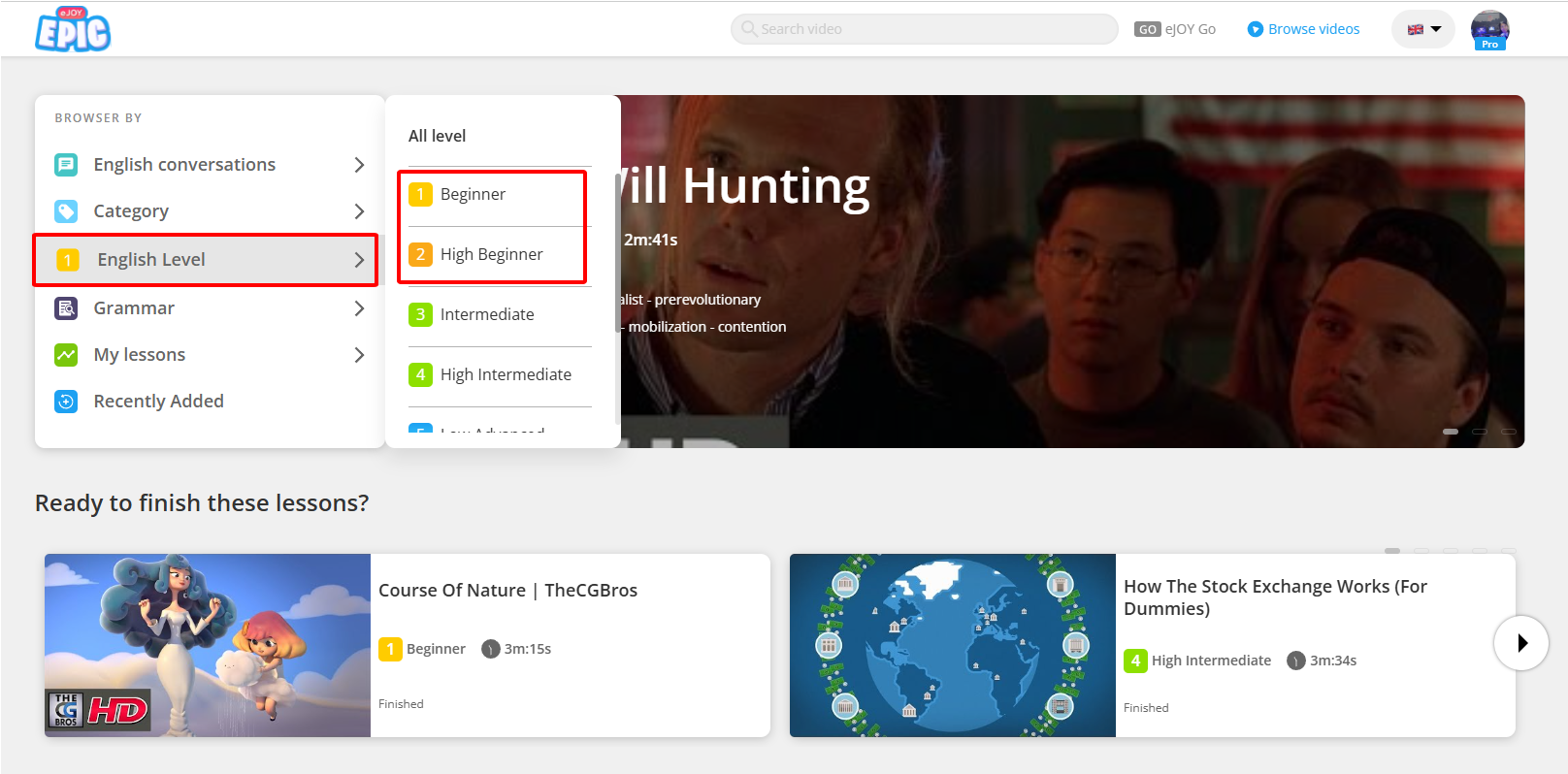
Step 3: After finishing the lesson, practice your Listening and Speaking skills with the same video.
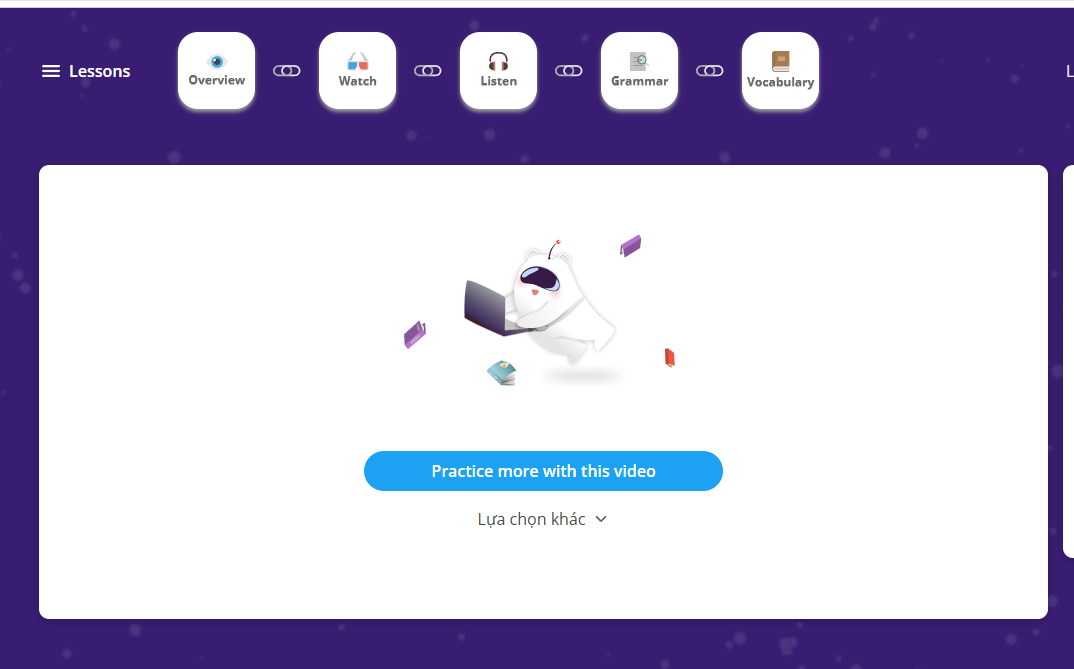
#3 Listening Input with Special Beginner Video Collection for Beginners
Instead of having to search for videos to "feed" (input) yourself, eJOY has already curated videos that fit your level perfectly into 2 specific sets:
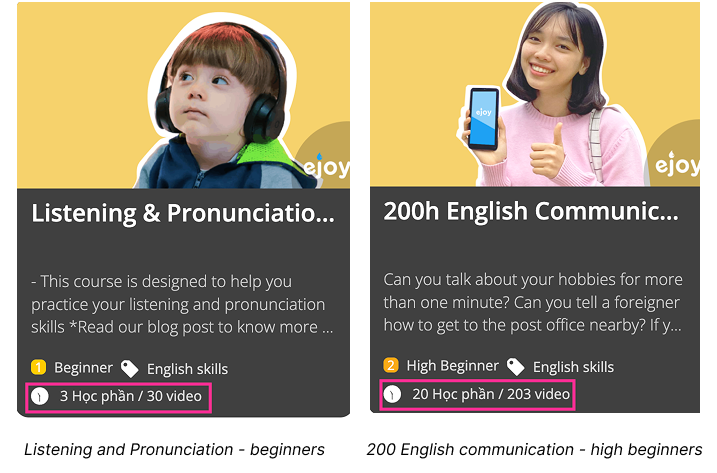
Your task is to listen repeatedly until you fully understand the video content. For the first few views, feel free to use bilingual subtitles and look up new words to grasp the meaning faster.
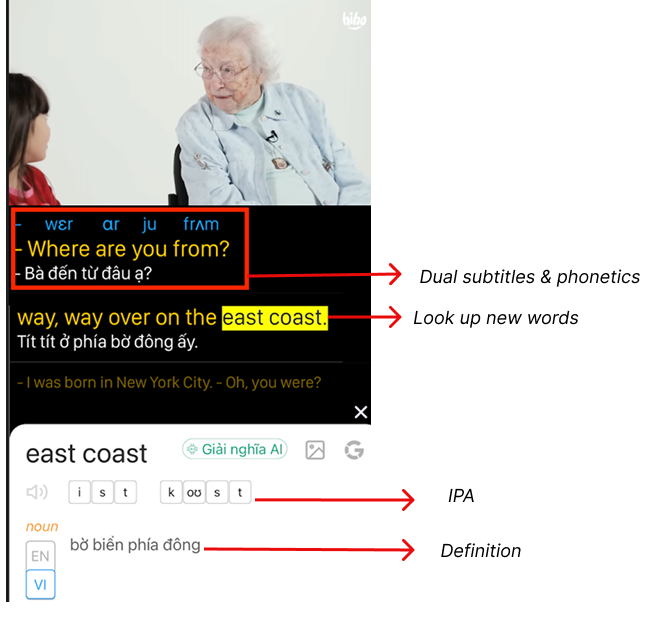
For videos you enjoy, practi ce every skill deeply with that video. This helps you remember vocabulary better and improves your Speaking and Listening skills.
All exercises give you the answer immediately after playing, so you know exactly where you went wrong and can try again. At this stage, don't pressure yourself to be 100% correct, especially with the Speak (Shadowing) game. Just opening your mouth to speak is already a huge success!

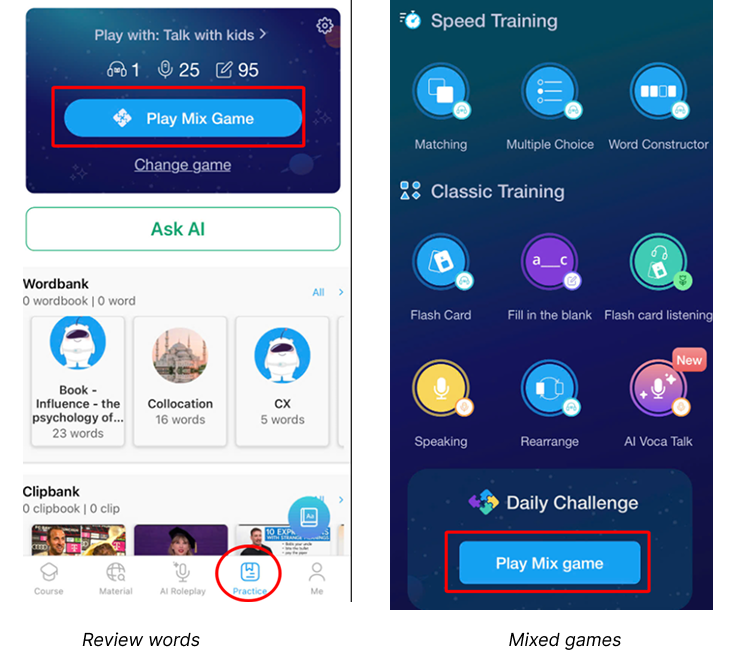
#4 Vocabulary Review
To deeply remember the words you have saved from courses or video sets, you should review them using Mixed Games. This helps you:
- Practice all 4 skills (Listening - Speaking - Reading - Writing) for the vocabulary.
- Study less but remember longer, thanks to the Spaced Repetition algorithm.
You can review on both your phone and computer.
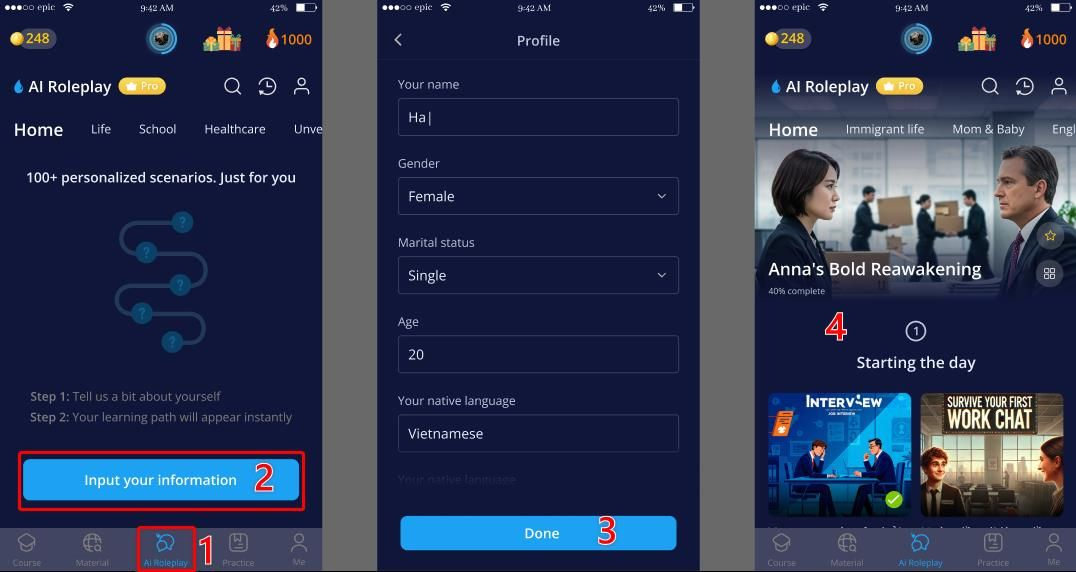
#5 Practice Speaking with AI
You don't need to "wait until you're good" to start speaking. At this stage, don't pressure yourself to speak beautifully or perfectly. Just opening your mouth and speaking along with the AI's suggestions is already a huge step forward.
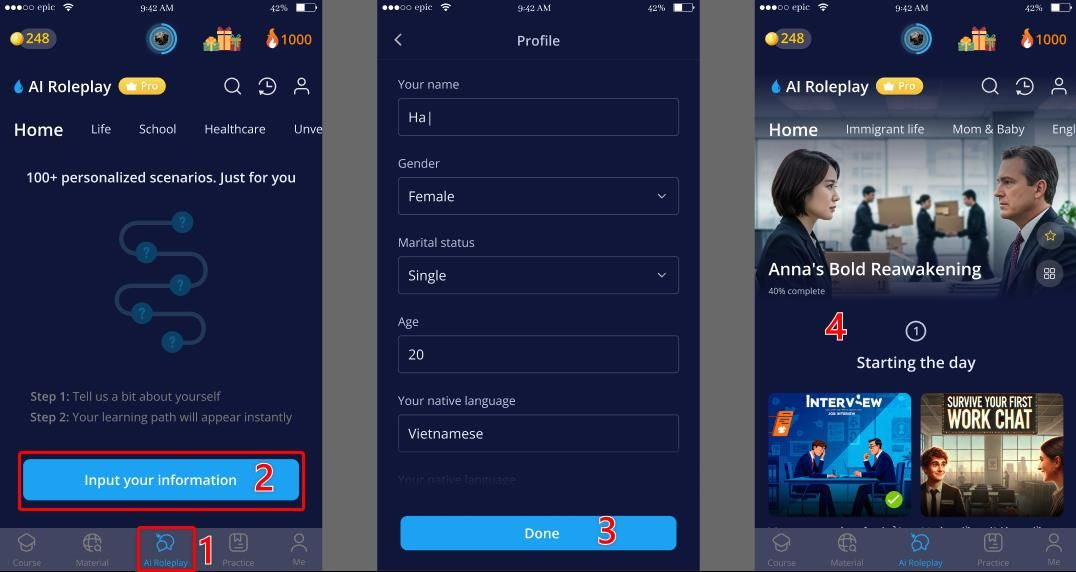
How to do it:
- Go to AI Roleplay.
- Input your information to create your personal English speaking scenarios
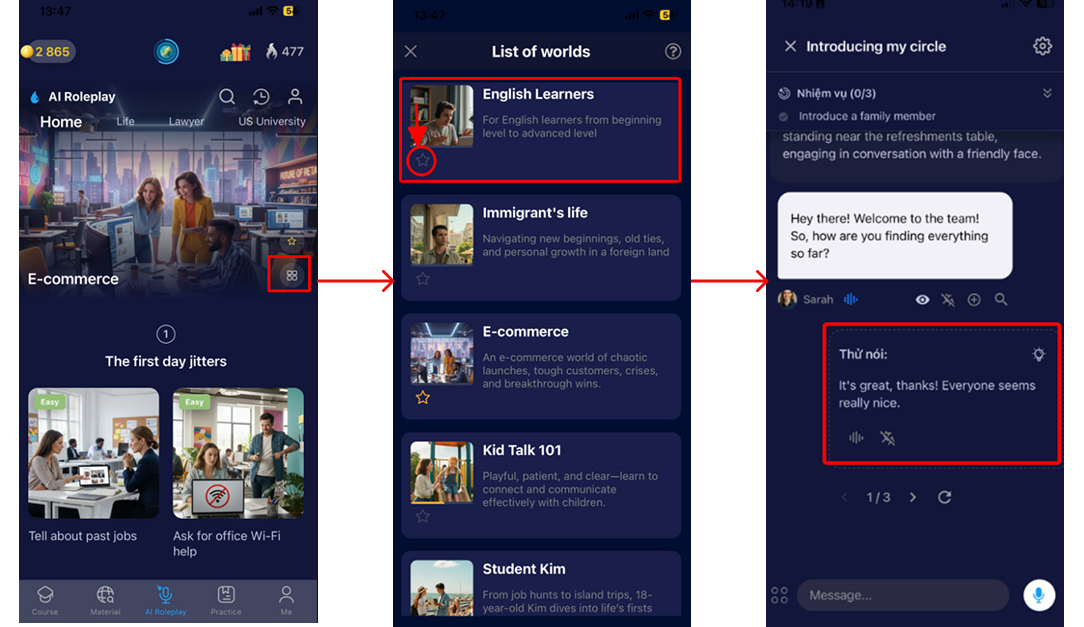
- Select the "English Learner" world.
- If you don't know what to say, just read the AI's suggestions aloud.
Create a Study Plan – Commit to B1/5.0 IELTS
After understanding the learning activities, the next step—and the deciding factor is planning to turn it into a real commitment.
As analyzed above, to go from A1/A2 to B1, you need at least 200 hours of active learning.
Begin by defining a clear timeline for your goal. For example, if you aim to communicate confidently in everyday situations at a B1 level within six months, plan to study for about 45–60 minutes each day (roughly 7–8 hours per week).
However, many people feel excited at first but "never quite start." This is often due to the fear of studying after a long break or bad experiences in the past. This is completely normal.
The secret is to start small but consistent to build momentum. If possible, find a group of friends at the same level to encourage and remind each other to keep the habit every day.
Divide your plan into 2 clear phases:
Phase 1: Warm-up (First 3-4 Weeks)
The goal of this phase is to build a daily learning habit. You only need 5 minutes/day to "start your engine" with simple activities like:
- Learning a short lesson in the Basic Everyday English 1 course (Activity #1).
- Or Speaking with AI using the available suggestions (Activity #5).
The most important thing in this phase is to maintain your Streak (your chain of continuous study days). When learning becomes a natural part of your day, increasing the study time won't be an obstacle anymore.
Phase 2: Acceleration
Once the daily habit is formed, start gradually increasing the time and variety of activities.
- Track Progress: Monitor your accumulated time on the eJOY app to see yourself moving toward the 200-hour goal. This helps maintain motivation.
- Balance: Make sure to balance the three main groups: Feed, Exercide, and Perform (F.E.P) using the 5 activities suggested above.

eJOY suggests the following milestones for this phase:
From B1 to Advanced Communication (B2+/6.5+ IELTS)
Once you reach Level B1, you can communicate confidently in most familiar situations. However, to communicate effectively, naturally, and professionally in work, studies, or daily life, you need to advance to Level B2 or higher.
On average, you will need at least 200 hours of active learning to reach this milestone.
Unlike the beginner stage where you mainly filled up with basic conversations, in the B1-B2 stage, you need to absorb content with more depth that is actually used by native speakers, such as TED Talks, movies, news, and stories. Consequently, your practice and application activities must also become more advanced.
Here are the suggested activities for you:
#1 Learn the "Basic Everyday English" Course (on Mobile)
Once you reach the B1 level, it is time to switch to the Intermediate Everyday English course. Just like the previous levels, these lessons are designed to upgrade your grammar, vocabulary, and listening skills. You will learn through real-life conversations spoken by native speakers. The main difference here is the difficulty - it is a step up from the Beginner level!
How to study:
- In each unit, you will practice listening, grammar and vocabulary with one video.
- After finishing the lessons in a unit, take time to practice deep listening and speaking with the conversation video at the end of the section
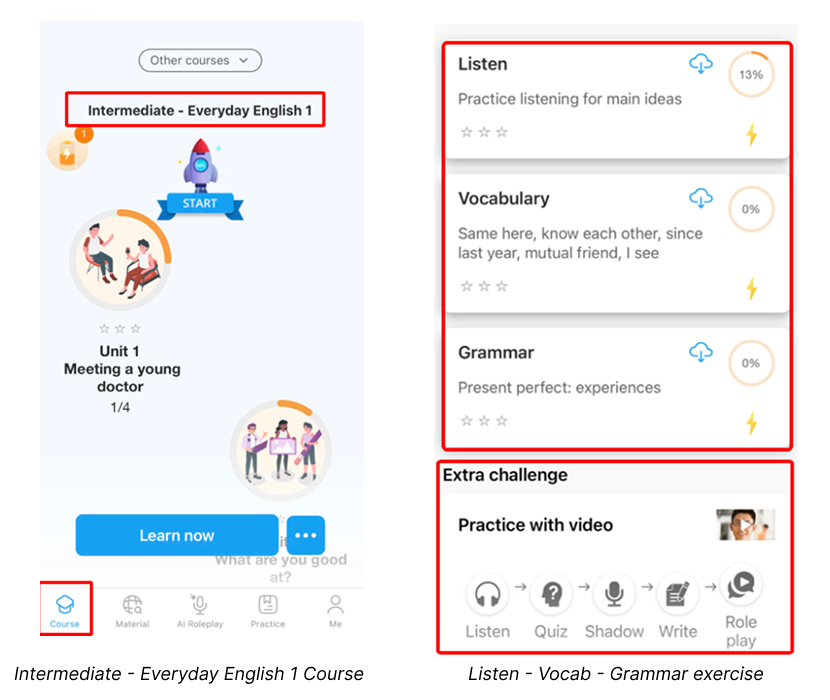
Your Learning Path: Start with Intermediate Everyday English 1. After you finish that, move on to Intermediate Everyday English 2, and finally Intermediate Everyday English 3.
#2 Learn advanced grammar
If you want to use English for work or exams, you need to learn advanced grammar. (Note: If you only want to communicate socially, you can skip this part!).
Here is the best way to master advanced grammar:
- Find your level: First, take the Entry Test in the book Cambridge Grammar. This test helps you find out exactly which grammar points you are weak at, so you don't waste time learning what you already know.
- Study the theory: Use the Cambridge Grammar for IELTS " by Diana Hopkins and Pauline Cullen book to learn the rules, theory, and new vocabulary for the topics you need to improve.
- Practice with EPIC: After studying the rules, go to EPIC Web. Use the filter to search for the Grammar Topic you just learned in the book. Watching these videos will help you see how that grammar is actually used in real life
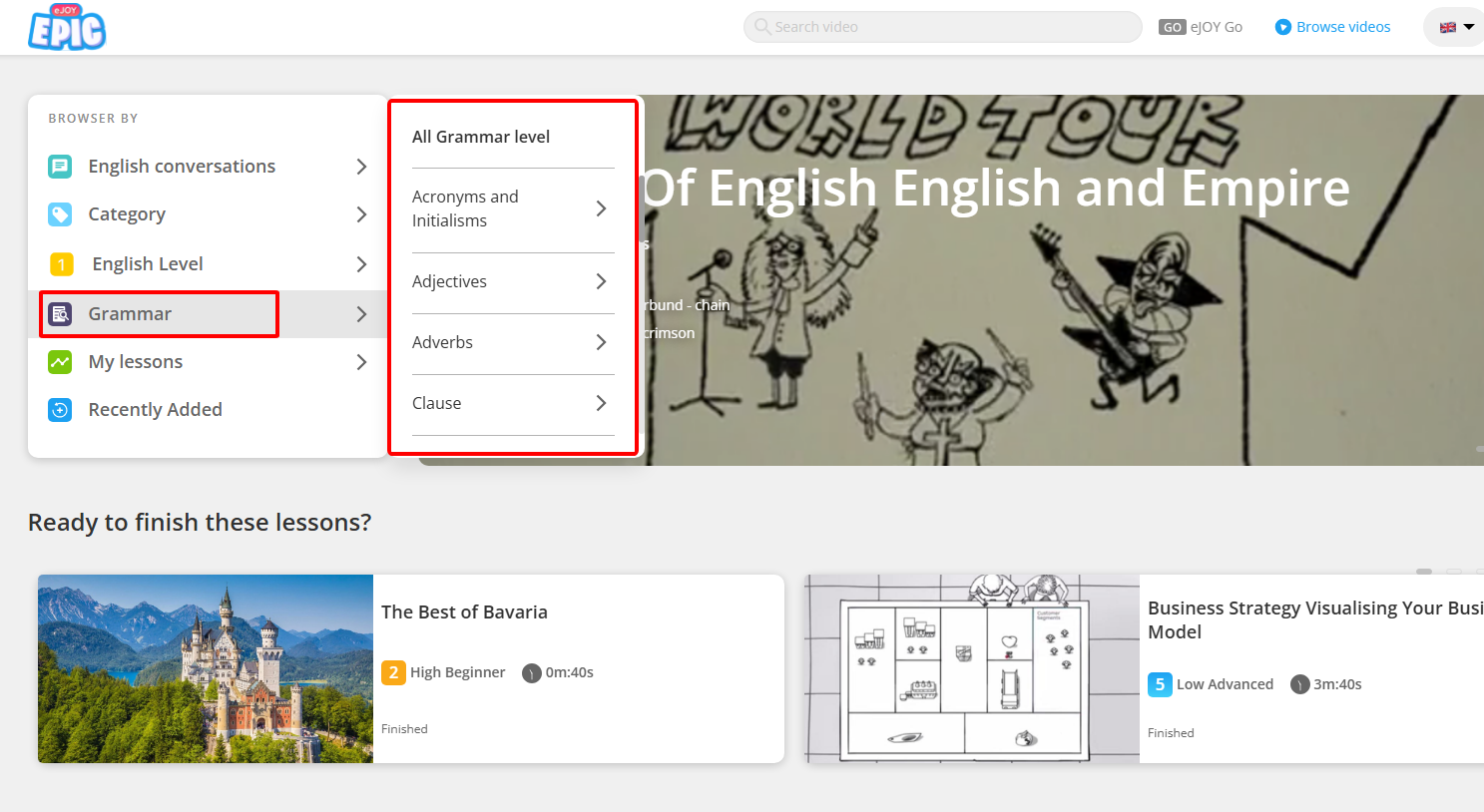
After you finish your grammar practice, you can use that same video on EPIC to practice your listening and speaking skills, too.
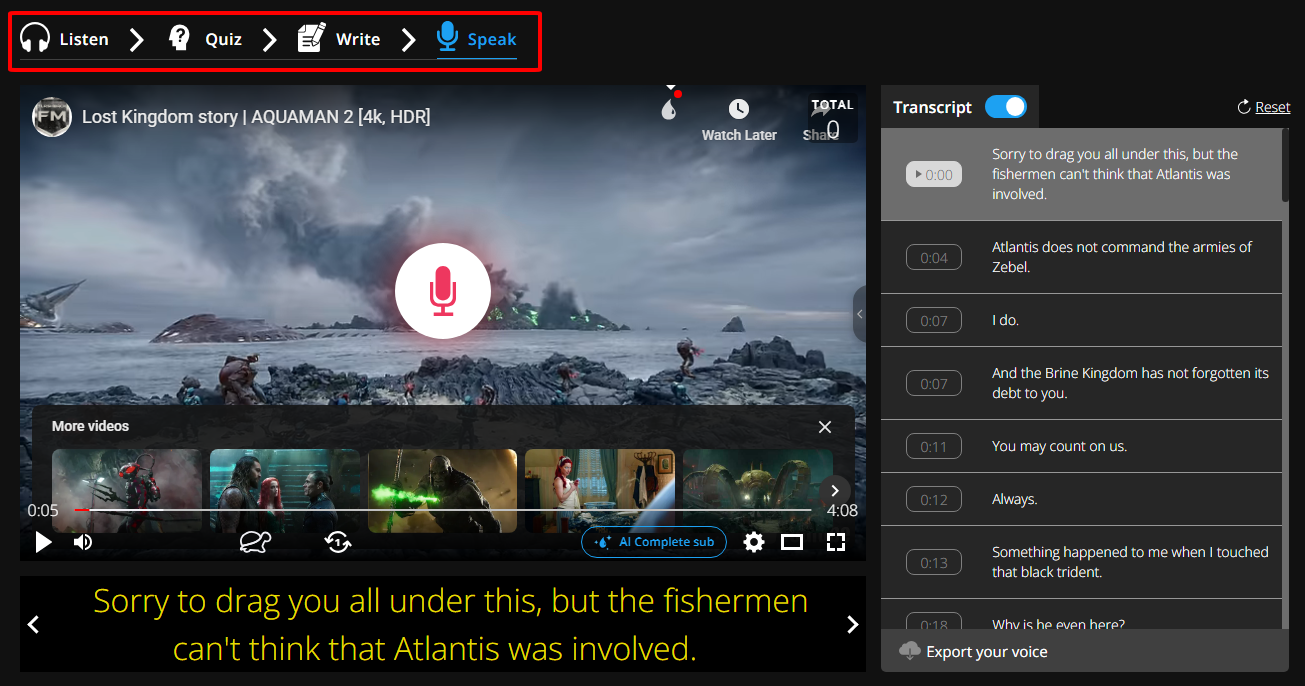
#3 Practice with TED Talk Collections
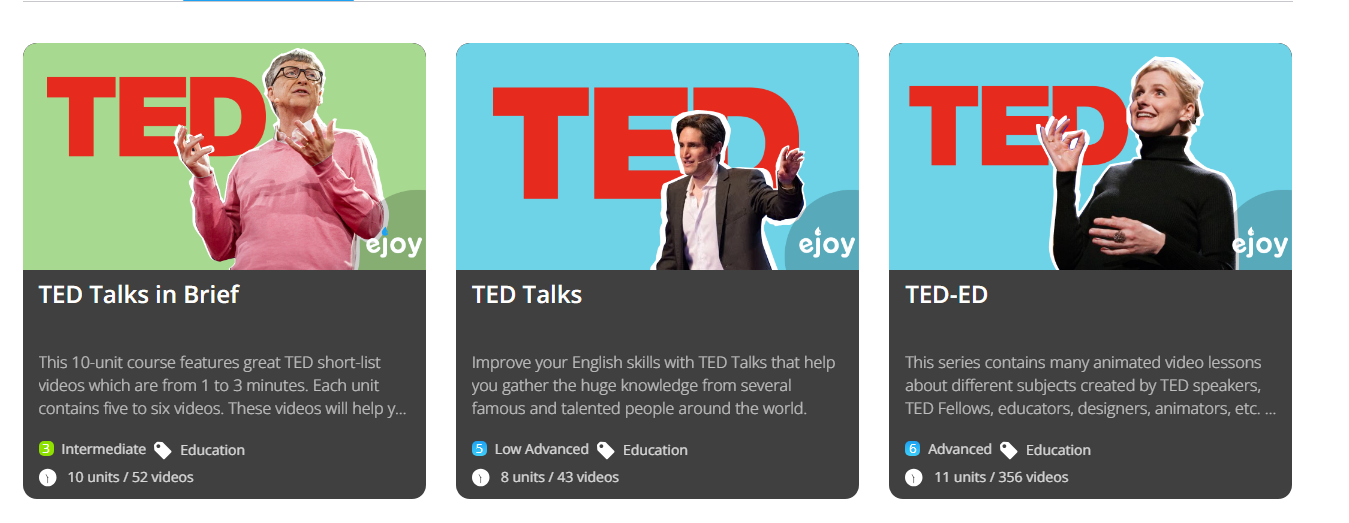
Now it is time to explore deeper content with diverse topics. eJOY suggests 3 TED Talk collections that gradually increase in difficulty.
These videos do more than just improve your daily communication. They give you great ideas and arguments for speaking. This is especially useful if you are planning to take the IELTS exam in the future.
Start with these collections:
- Ted Talks in Brief collection– Level B1 (1.9 hours of watching)
- Ted Talks collection – Level B2 (11 hours of watching)
- TED-ED – Level C1 (35.6 hours of watching)
How to study effectively:
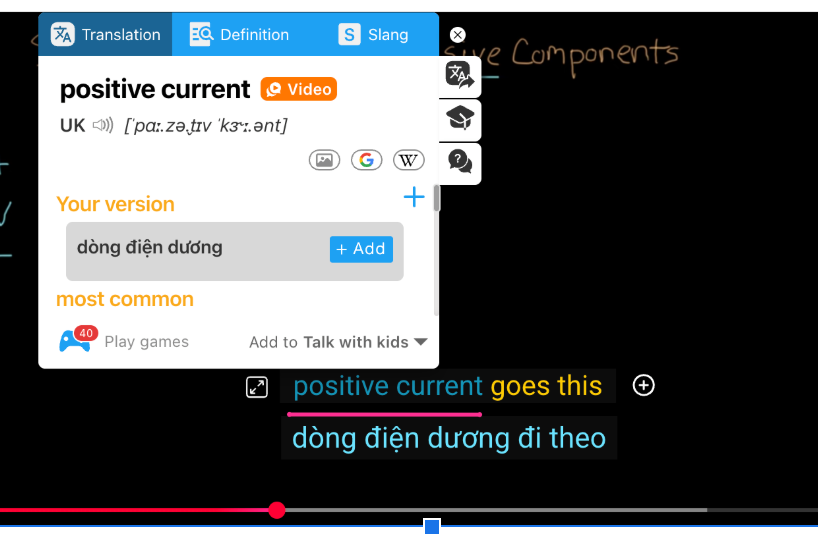
- Save Vocabulary: While watching, make sure to save any new words you want to learn.
- Deep Practice: For the videos you really like, practice all 4 skills: Listening, Speaking, Reading, and Writing. This helps you turn what you have learned into a natural reflex.
#4 Read English Stories
Watching videos helps you with listening and natural intonation. But reading helps you go deeper. It helps you understand the meaning, sentence structure, and the feelings behind the words.
When you read, you will see how native speakers connect ideas. This is something you might miss when just watching videos.
How to read effectively:
- Read and Guess: Read the text first and try to guess the meaning. Don't look up every new word immediately!
- Spot Good Phrases: Pay attention to sentences or phrases that you find interesting or useful.
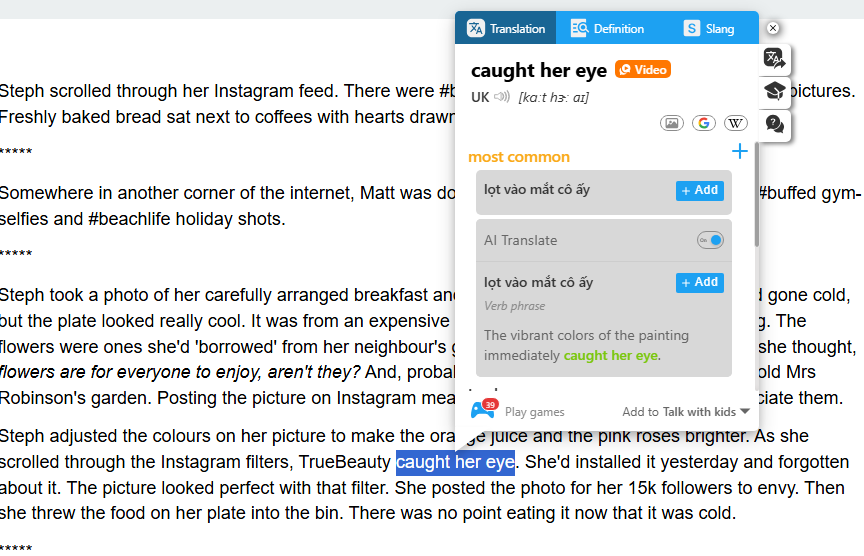
- Use eJOY: Now, use eJOY to look up the new words and phrases.
- Save Them: Save these words to your review list. This becomes your "data bank" for writing and speaking later.
💡 eJOY Suggestion:
- The "9 Stories for B2–C1" collection on the British Council website is a great place to start deep reading.
- Install the eJOY AI Extension on your computer (Chrome/Edge) to easily look up and save words while browsing
#5 Review to Make Vocabulary "Yours"
If you save words but never look at them again, your brain will forget them quickly. Reviewing is the key step to turn temporary knowledge into long-term memory.
With eJOY, you don't need to stress. The system uses Spaced Repetition. This means it will automatically remind you to review a word right before you are about to forget it.
How to review:
- Don't just read: Don't just look at the meaning.
- Play Games: Use eJOY's Mixed Games to practice all 4 skills: Listening – Speaking – Reading – Writing. This method ensures you don't just understand English, but can actually use it to speak and write.
You can review anytime, anywhere, on your phone or computer!
#6 Practice Speaking with AI
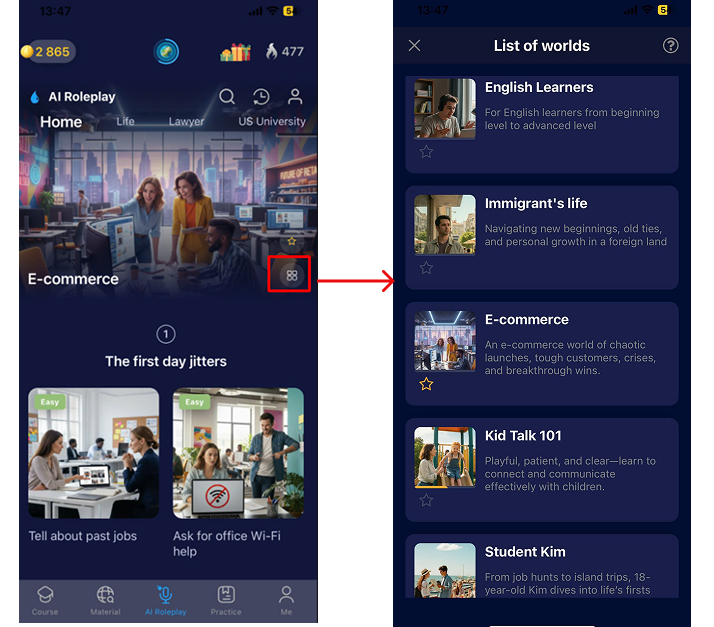
Now it is time to "Perform." This is where you use everything you have learned to communicate. eJOY has built AI Speaking Worlds that are personalized just for you. The AI knows your age, gender, and interests to create conversations that fit your life.
If you have specific goals—like moving abroad, studying overseas, working in an international office, or speaking with your children—you can switch to a Specialized World. This helps you focus your practice on exactly what you need.
And the best part? You can speak as many times as you want. You don't have to worry about making mistakes or being judged.
eJOY AI is always ready to listen. It gives you feedback on your grammar and vocabulary mistakes. It even suggests better ways to express yourself, which you can save to review later.

#7 Improve Your Professional Skills
Besides practicing daily conversation, you can use English to learn about your actual job or major. This allows you to use your English skills to understand real professional content. It hits two targets at once:
- You improve your English.
- You improve your career skills
How to start:
- Start with what you know: First, choose courses related to your current job. Because you already understand the topic, it will be easier to understand the English. You can also apply what you learn immediately.
- Expand later: Once you are comfortable, try learning about other fields. This helps you build a rich vocabulary and gain new ideas. This is very useful if you plan to take the IELTS exam or work in an international company.
💡 eJOY Suggestion: You can take great courses on Coursera, Udemy, KhanAcademy, or LinkedIn. Don't forget to use eJOY to watch these videos with dual subtitles (two languages at once) and look up or save new professional terms instantly.
Create a Study Plan – Commit to B2+/6.5+ IELTS
Now that you know what to learn, the next step is to decide how to do it. You need a plan to turn your goal into a real commitment. As mentioned before, to go from B1 to B2, you need at least 200 hours of active learning.
Start with these 3 steps:
- Set a clear deadline: For example, aim to reach B2 in all 4 skills by June 2026.
- Calculate your pace: To finish 200 hours in 8 months, you need to study about 45–60 minutes per day (or 7–8 hours per week).
- Track your progress: Use the eJOY app to record your time. Seeing your hours go up helps you feel closer to the finish line.
How to Avoid Quitting
Many people feel excited at first, but never actually start. Maybe you haven't studied for a long time, or you had a boring experience in the past. This is completely normal. The secret is to start small, but be consistent. To avoid giving up after a few days, divide your plan into two stages:
Stage 1: Warm Up (First 3-4 Weeks)
Goal: Build a daily habit. You only need 5 minutes a day to start. Choose simple activities like:
- Learn a short lesson in the Intermediate Everyday English Course
- Learn an advanced grammar topic
- Watch 1 English video (TED or similar).
- Review your vocabulary.
- Practice Speaking with AI using the suggested topics.
The most important thing is to keep your streak (learning days in a row). When learning becomes a natural part of your day, studying for longer will feel easy.
Stage 2: Speed Up
Once you have the habit, start increasing your study time and trying different activities. Keep tracking your total hours on eJOY to stay motivated until you hit that 200-hour goal!

In addition to the steps above, you need to find a balance between 3 main groups of activities: Feed, Exercise, and Perform (F.E.P). You will do this by using the 7 activities we just discussed.
eJOY suggests following the specific milestones below. These clear goals will give you the motivation to complete your study plan every day.
(*) Note: If you don't find the suggested stories or videos interesting, feel free to replace them! You can choose other content at the same level. Just make sure you spend the same amount of time studying.
Ready to Start?
We hope that after reading this post, you have mastered the 4 Golden Rules to communicate confidently. You are now ready to start your own journey to conquer English!
So, what are you waiting for? Create your study plan and start practicing today!
If you have any questions, please message us on the eJOY English Fanpage. The eJOY team is always ready to support you!
💙